

Continuum — Phase I | Fracture (2026)
Containment
BelliranER
Containment
I remember being a vast ocean
Where the entire existence around felt open.
I remember being the water that gave life
Where every wave felt alive.
I remember seeing the horizon
Where every inhale of air felt like freedom.
I remember every river who touched and mixed with my water
Where a billion combinations of life became possible.
I remember the horizon drawing closer day by day,
I used to be the bringer of life but now of decay.
The wind that once flew over my waves with grace —
No longer can be felt over my water, nor over my face.
I used to be the bringer of life — now just part of the fog,
I'm a raging sea, trapped in a raindrop.
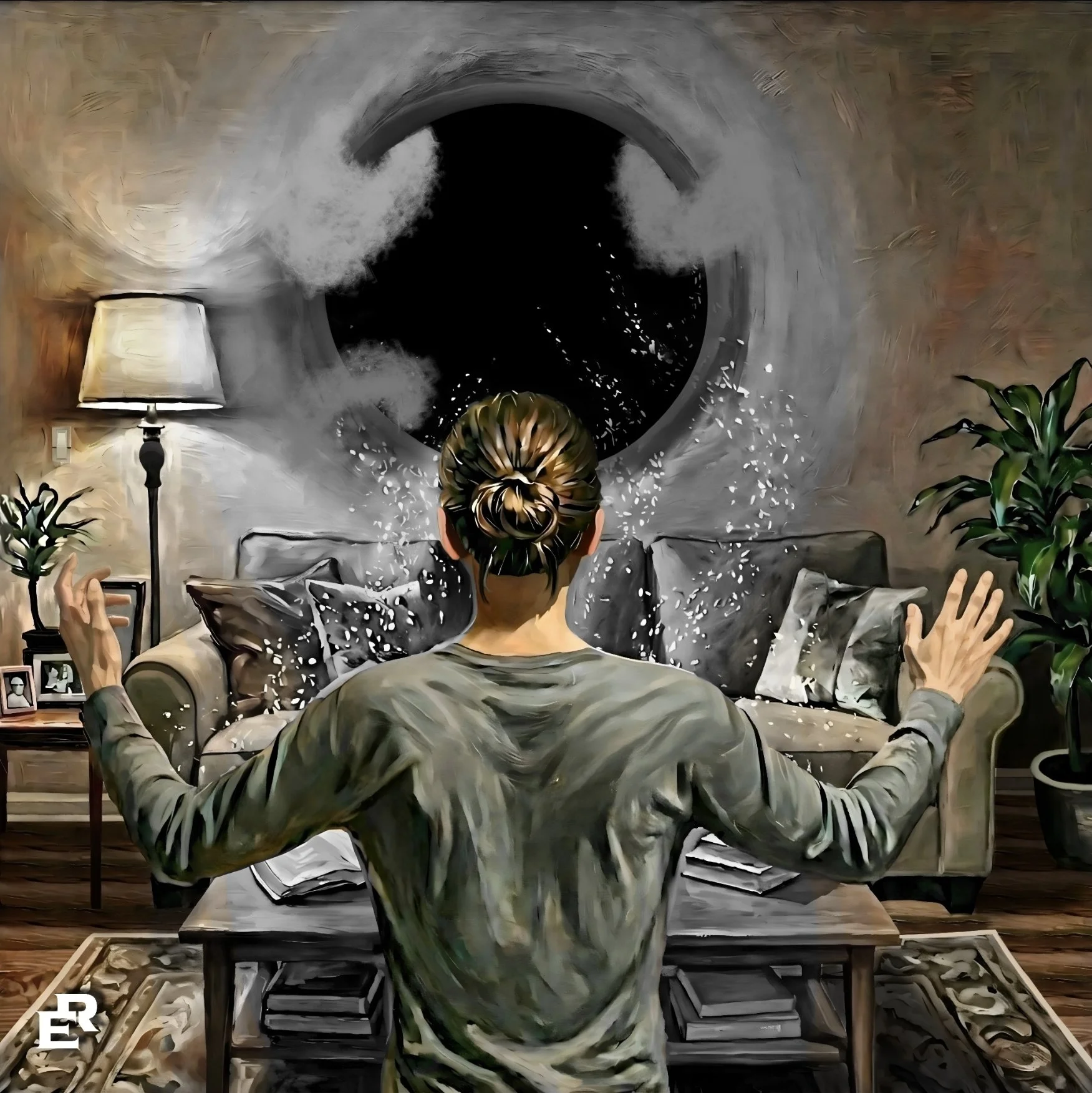
The following text does not explain the work.
It reflects what shaped it.
Containment explores a condition in which awareness and confinement exist simultaneously.
The figure does not stand before an unknown force.
He stands before something he recognizes.
The black opening is not presented as an event, a destination, or a mystery waiting to be solved.
It remains present as a condition:
a force that draws inward,
altering the atmosphere around it.
Light is pulled toward it.
Color recedes into it.
Movement bends in its direction.
Even the air itself appears unable to remain untouched.
The room does not collapse.
The walls remain standing.
The objects remain in place.
Yet something within the space has changed.
Containment exists through two forms of enclosure.
The first is structural.
The room functions as a boundary:
a familiar environment whose limits quietly define the space in which the figure lives.
It is ordinary, recognizable, and unchanged.
The second is internal.
The black hole represents a condition that cannot simply be left behind.
Its influence extends beyond its physical presence.
It acts upon the atmosphere of the room itself—drawing light, color, movement, and even air inward, while gradually altering the space in which the figure remains.
Together they create a paradox:
one containment surrounds the body,
while the other surrounds possibility.
The room contains the figure through structure.
The condition contains him through influence.
One establishes the limits of space.
The other narrows the horizon within it.
The figure is aware of both.
Nothing within the work suggests ignorance.
The loss is visible.
The contraction is visible.
The pull is visible.
Even the movement of the room itself appears to acknowledge its presence.
Yet awareness alone does not dissolve the condition.
The figure remains within it.
Not consumed.
Not defeated.
Contained.
Poem Reflection
The poem and artwork emerged in parallel.
Neither explains the other.
Instead, both approach the same condition through different forms of language.
Within the poem, that condition appears through scale:
an ocean,
a horizon,
rivers,
fog,
and a raindrop.
Within the image, the same condition appears through space:
a room,
a figure,
a void,
and the gradual contraction of what surrounds them.
The line,
"I'm a raging sea, trapped in a raindrop,"
became the point at which both forms converged.
The sea represents magnitude:
the ability to move,
to expand,
to connect,
and to become more than its present boundaries.
The raindrop represents containment.
Not because it destroys the sea,
but because it cannot hold what the sea truly is.
The room within the artwork becomes a reflection of that same paradox.
Like the raindrop, it contains.
Like the horizon in the poem, it limits expansion.
And like the black hole, it participates in the gradual narrowing of possibility.
Containment is therefore not a portrait of darkness.
It is a portrait of magnitude living within the restrictions of PTSD and depression.
A vast ocean remembering its horizon from within the walls of a room.