

Still Mine to Rebuild
BelliranER
The following text does not explain the work.
It reflects what shaped it.
The work does not present rebuilding as a response to ruin.
It holds a condition in which destruction, habitation, and reconstruction exist simultaneously.
Parts of the structure burn.
Parts remain capable of shelter.
Elsewhere, another dwelling already begins to take form.
Nothing waits for the fire to end.
Life continues where it still can.
Rebuilding begins before loss has concluded.
What emerges is not a passage from collapse toward restoration,
but the recognition that opposing conditions often occupy the same space.
Ruin does not replace life.
Life does not erase ruin.
Both remain.
The work sustains the tension between what is burning,
what endures,
and what is still being built.
Here, continuation is not found beyond the damage.
It exists within it.
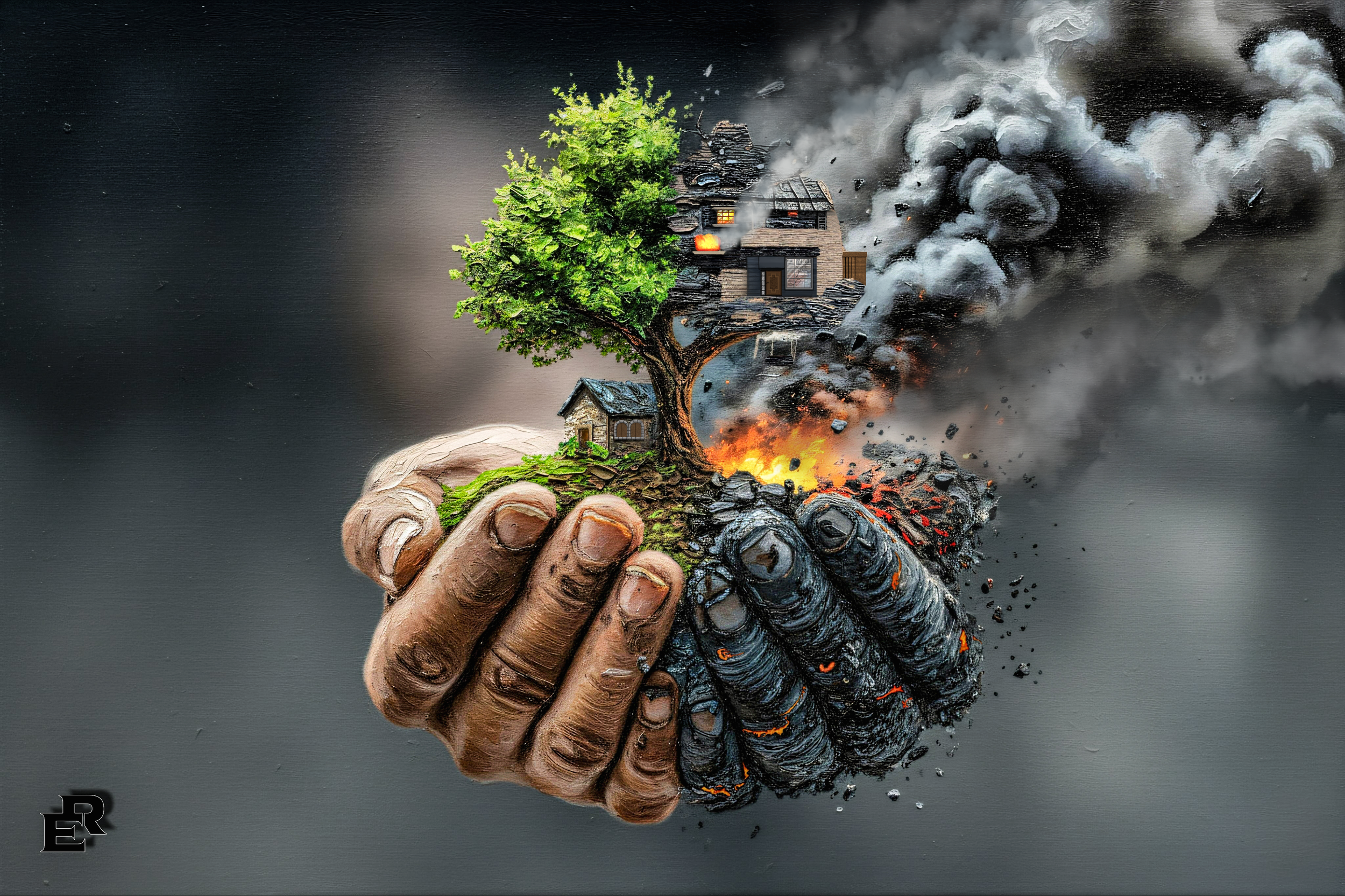
Unwilling to fade — I endure and remain.
What burned still lived,
what remained learned to forgive.
For while one shelter learned the language of ash and soot,
another learned the shape of stone and root.
While embers carried away what could not remain,
new foundations were laid by hands alone despite the pain.
The ruin was mine.
The rebuilding too.
Not because either could be controlled,
but because both asked to be carried through.
And so I held them—
the house still burning,
the house I'm building,
the life that trembled,
the life returning,
It did not end where the fire passed.
Something within remained —
not untouched,
unwilling to fade,
refusing to be afraid.
And in that stillness, I knew:
In these hands lived both ruin and life —
but the end was still mine to rebuild.